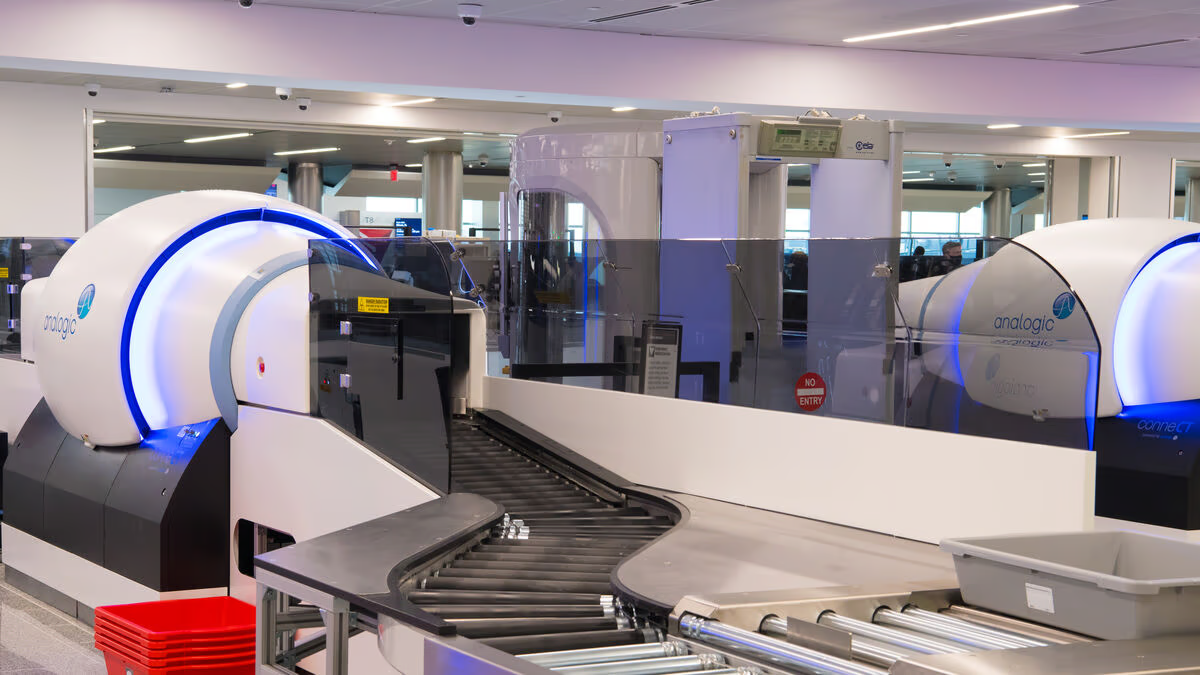
A new era in airport security is beginning with the implementation of 3D scanners at major international airports. This revolutionary technology allows passengers to keep liquids and electronic devices inside their baggage during security screening.
First implementations
Stansted Airport has been one of the pioneers in testing this new security equipment. Mark Harper, the United Kingdom's Secretary of State for Transport, announced that the 100 ml liquids restriction would be removed, allowing containers of up to two litres.
Advantages of the new technology
The new scanners are computed tomography (CT) X-ray machines that produce high-resolution volumetric 3D images. This technology makes it possible to:
- Keep electronic devices in baggage.
- Carry liquids in containers of up to 2 litres.
- Keep toiletries in baggage.
- Significantly reduce waiting times.
"Thanks to improved scanning technology, it will become increasingly rare for bags to be opened for closer examination. This will speed up the security-control process and make it more comfortable." - Sami Kiiskinen, Vice President of Airport Development at Finavia
International implementation
The adoption of this technology is a global trend. Airports such as Amsterdam Schiphol and Helsinki have already implemented these systems. In the United States, the TSA has carried out tests at fifteen airports, including Los Angeles, Oakland, San Diego and Chicago.
Implementation deadlines
The United Kingdom set June 2024 as the deadline for its airports to upgrade their security systems. Other countries are expected to follow a similar implementation timetable.
Key benefits
- Removal of the 100 ml limit for liquids.
- No need to remove electronic devices.
- Significant reduction in waiting times.
- Greater accuracy in threat detection.
- Improved traveller experience.
Pioneer airports
- London Stansted (United Kingdom).
- Amsterdam Schiphol (Netherlands).
- Helsinki-Vantaa (Finland).
- Los Angeles International (United States).
- Chicago O'Hare (United States).