

In the complex ecosystem of an airport, where thousands of operations are coordinated every second, there is a silent but essential language for security: personal airport accreditations. These cards, visible on each worker's uniform, are much more than a simple ID. They are the pass that opens or closes doors inside one of the most controlled environments in the world.
In this guide, we explain clearly and in detail what each colour means, how permits work and which responsibilities apply to people who carry them in Spain.
The basics of airport accreditation
Before decoding the colours, it is useful to understand what sits behind these accreditations:
- Official definition: an airport accreditation is any medium, such as a card, sticker or printed pass, that identifies and validates a person authorized to access specific airport areas. It is issued exclusively by the airport authority.
- Operational need: access to different areas is not granted by professional category or rank. It is only authorized when the job requires presence in that area.
- Background checks: no one may access the ZRS (Zona Restringida de Seguridad) without passing a prior background check. The worker must authorize the Ministry of the Interior to check their criminal-record data before receiving the accreditation.
Decoding the colour code
Each colour on an accreditation immediately defines which areas the holder may enter.
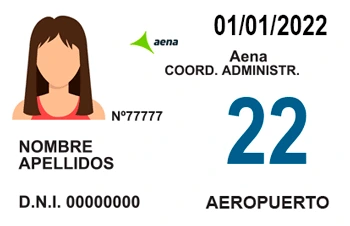
Red - Public area
Access and presence only in areas open to the public, such as check-in halls, arrival areas or unrestricted offices.
Blue - Controlled Access Area (CAA)
Allows entry into controlled areas where physical security screening is not required, such as baggage reclaim halls or certain internal corridors.
Yellow - Restricted area (airside, exterior)
Authorizes work in the exterior aeronautical area, such as aprons and service roads, but does not allow access to the terminal interior, the baggage sorting area or the manoeuvring area.
White - Restricted area (airside, terminal interior)
Allows access to secure areas inside the terminal building. It is common among staff working in shops, restaurants or boarding gates located after security screening.
Green - Broad access
This is the pass with the widest scope. It allows access to almost all airport areas except two critical areas: the manoeuvring area and the baggage sorting area.
Special markings: extra access layers
In many cases, the base colour of the card is complemented by codes or markings that extend permissions:
- Letter "P" (Runway): authorizes access to the manoeuvring area, including runways, taxiways and perimeter areas.
- Red stripe: authorizes access to the baggage sorting area, where hold baggage is processed and classified.
- Additional printed letters: some accreditations include letters identifying specific zones, providing more granular access control.
Temporary types
Not all passes are permanent. The system includes one-off accreditations for visits and escorted access:
- Visits (V): valid for a maximum of one day and always requiring escort.
- Operational escort (A): the authorized worker must accompany the visitor at all times and ensure that security rules are followed.
When lines are crossed: sanctions and consequences
Misuse of an airport accreditation is not a simple mistake. It is an infringement that can have serious consequences.
- Administrative sanctions: Spain's Air Safety Act 21/2003 classifies unauthorized access to restricted areas as a serious infringement. Fines may reach 90,000 euros.
- Withdrawal of accreditation: the airport authority may immediately revoke an accreditation or vehicle authorization. Without it, the worker will not be able to continue performing their duties, which could lead to job loss.
More than a pass: a commitment
Airport accreditations are, in practice, an implicit contract between the security system and the worker. Each colour and each letter implies a level of responsibility. Knowing the rules and respecting them is not only an obligation; it is a key part of keeping everyone safe.