Aviation security has been one of the most closely monitored and regulated areas of the transport sector because of the scale and reach of the threats it faces. From terrorist attacks to passenger incidents, each significant event has forced authorities and international organizations to review and strengthen AVSEC (Aviation Security) measures, continuously improving protocols to prevent future tragedies. Below, we examine some of the most notable incidents and the lessons that have shaped today's aviation security.
Lockerbie (1988)
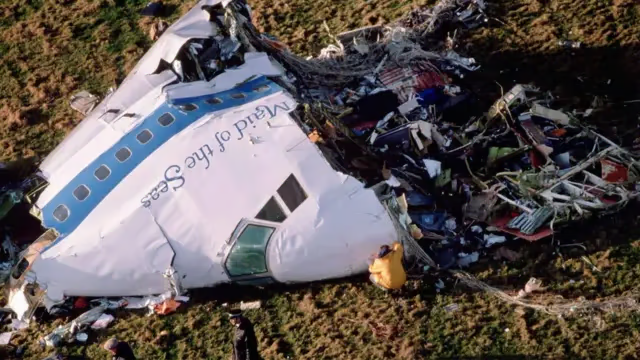
The Lockerbie bombing, which occurred on 21 December 1988, was one of the most devastating aviation security incidents in history. Pan Am Flight 103, operating the London-New York route, exploded in mid-air because of a bomb placed in the baggage hold, killing 270 people, including 11 residents of the small Scottish town of Lockerbie where the aircraft wreckage fell.
"The Lockerbie tragedy marked a before and after in global aviation security."
Lessons learned
- Introduction of Positive Passenger Bag Match (PPBM): after Lockerbie, checked baggage had to be linked to the passenger who checked it in. If a passenger did not board, their baggage had to be removed from the aircraft.
- More rigorous baggage controls: airport explosive-detection systems were significantly improved after the attack.
- International regulation: international organizations such as ICAO (International Civil Aviation Organization) established new global rules.
The attacks of September 11, 2001
On September 11, 2001, four commercial aircraft were hijacked by terrorists affiliated with Al-Qaeda, who crashed two of the aircraft into the Twin Towers in New York and a third into the Pentagon. The fourth aircraft, headed for another target, crashed in Pennsylvania after passengers intervened. In total, nearly 3,000 people lost their lives in the attack.
"September 11 changed the history of airport security forever."
Lessons learned
- Creation of the TSA (Transportation Security Administration): the United States created the TSA, a dedicated transport-security agency.
- Reinforced cockpit doors: cockpit doors were strengthened with bullet-resistant materials.
- Passenger screening protocols: measures were introduced to screen all passengers, with greater emphasis on detecting suspicious behaviour.
- Introduction of no-fly lists: no-fly lists were created to prevent dangerous individuals from boarding commercial flights.
- Body scanners and advanced technology: advanced body scanners were implemented at airports.
Conclusions
Each of these incidents, though tragic, has had a lasting impact on commercial aviation security. AVSEC rules and procedures have evolved thanks to the lessons learned from these events, with the aim of preventing them from happening again. The aviation industry and security authorities continue working to anticipate new threats, adopting cutting-edge technologies and building international cooperation so passengers can fly safely.
Learn more and access the AVSEC course to train in one of the most important areas of airport security.